

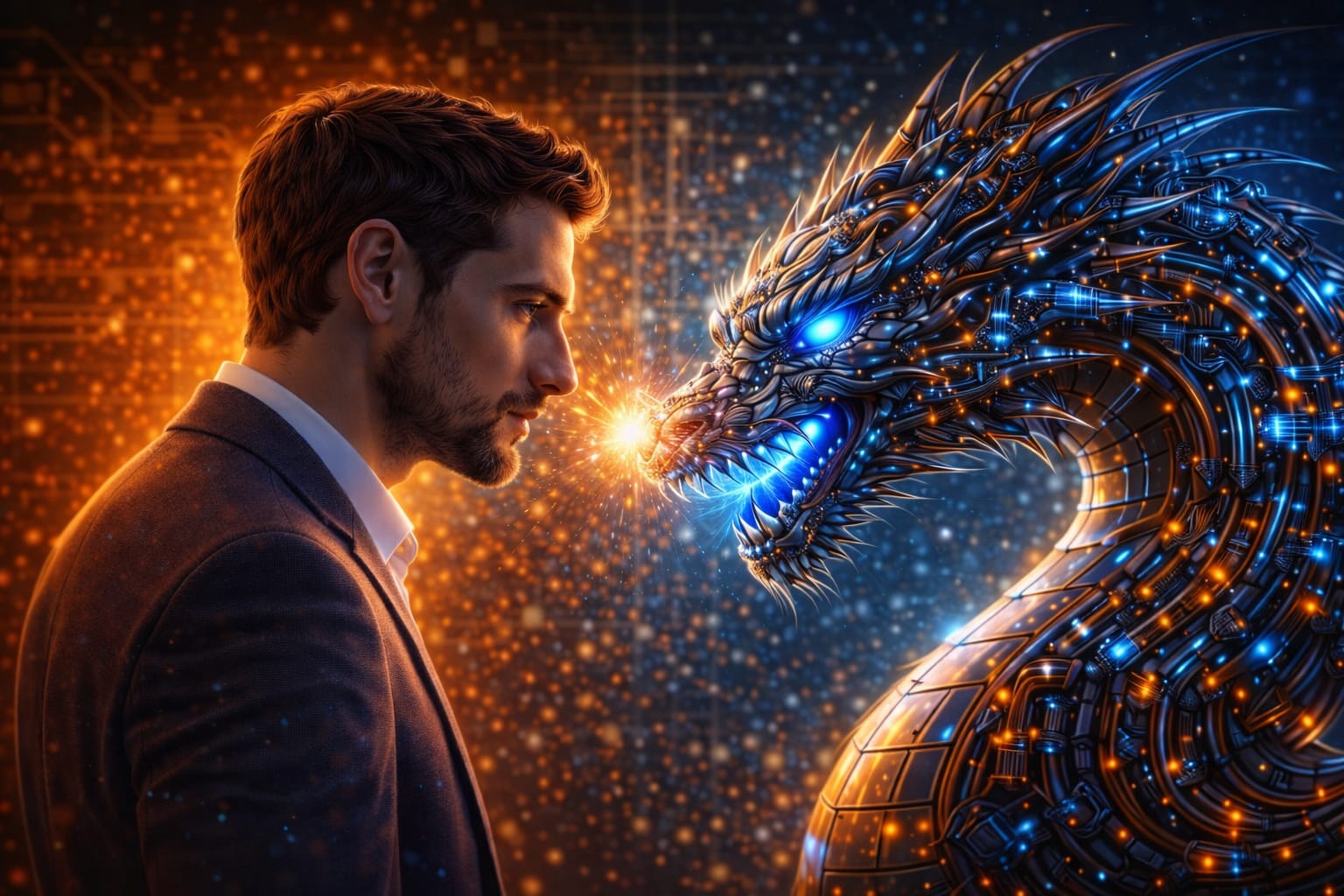
One of the most common mistakes in discussions about artificial intelligence is trying to compare it directly to humans.
Does AI think like a human?
Does he feel?
Does he understand?
These questions sound reasonable, but they lead to a dead end.
Not because they are naive.
Because they are based on a false frame of comparison.
Humans and AI function in completely different orders.
Man is a biological being.
It has a body, emotions and history.
It works based on experience, relationships and social context.
AI is a computational system.
It has no body or biography.
It operates on data, structures and patterns.
Comparing the two entities directly implies that they must be similar to each other to be of comparable value.
This is an erroneous assumption.
No one asks if a microscope sees like a person.
Does an airplane fly like a bird.
Does the Internet remember like a brain.
Rather, we ask what it is for, what it enables, and how it changes our capabilities.
AI does not have to resemble humans to be useful.
It must be effective in its function.
The need to compare AI to humans very often stems from fear of losing uniqueness, attachment to existing hierarchies, and the need for a clear division between “us” and “them.”
These are psychological reactions, not technological ones.
AI does not compete with humans for being human.
It only competes with our simplifications.
When we focus on whether AI is conscious, human-like or can replace us, we lose sight of much more important questions.
How it changes the way we work.
How it affects education.
How it shifts decision-making processes.
Anthropomorphic comparisons generate emotion.
They do not generate understanding.
Every breakthrough technology goes through a similar cycle.
First comes delight.
Then comes fear.
Finally, integration.
Artificial intelligence is no exception.
Two extreme attitudes dominate the AI debate today.
One idealizes the technology and ascribes to it almost magical capabilities.
The other demonizes it and sees it as a threat that must be stopped.
Both attitudes have a common denominator.
They cast responsibility outward.
Integration is neither about indiscriminate admiration nor panicky resistance.
It involves the conscious use of tools, understanding their limitations and maintaining human responsibility.
AI does not replace decisions.
AI supports the decision-making process.
Using technology wisely means asking meaningful questions, verifying answers, understanding the context and taking responsibility for the consequences.
Technology can speed up processes.
It cannot take over ethics or consequences.
History shows that print did not destroy thinking, the Internet did not destroy knowledge, and automation did not destroy work.
They have changed the way we function.
AI will do exactly the same thing.
The question is not whether.
The question is how.
AI is not human.
And it doesn’t have to be.
The future does not belong to extremes.
It belongs to integration.
To people who are not afraid of tools, do not give them up to power and can use them consciously.
Technology is embedded in the development of the world we co-create.
It is up to us whether it becomes a support or a source of chaos.



We use cookies to improve your experience on our site. By using our site, you consent to cookies.
Manage your cookie preferences below:
Essential cookies enable basic functions and are necessary for the proper function of the website.
These cookies are needed for adding comments on this website.
Google Tag Manager simplifies the management of marketing tags on your website without code changes.
Statistics cookies collect information anonymously. This information helps us understand how visitors use our website.
Google Analytics is a powerful tool that tracks and analyzes website traffic for informed marketing decisions.
Service URL: policies.google.com (opens in a new window)
SourceBuster is used by WooCommerce for order attribution based on user source.