
Liposomy a biodostępność substancji bioaktywnych
Biodystrybucja, czas działania i porównanie z innymi formami podania
Wiele substancji bioaktywnych pochodzenia naturalnego wykazuje bardzo niski poziom wchłaniania w klasycznych formach doustnych. Problem ten dotyczy szczególnie związków słabo rozpuszczalnych w wodzie, o dużej masie cząsteczkowej lub podatnych na degradację w przewodzie pokarmowym.
Do tej grupy należą m.in.:
kurkumina i inne polifenole,
resveratrol,
quercetin,
Plant triterpenes (e.g. betulin),
coenzyme Q10,
Vitamin C in high doses,
numerous adaptogenic extracts.
For this reason, technologies have been developed over the years to improve the bioavailability and distribution of these substances in the body. One of the best studied is liposomal technology.
What are liposomes and why do they change pharmacokinetics?
Liposomes are microscopic vesicles made of phospholipids, the same structures that make up natural human cell membranes. This makes them biologically compatible and well tolerated by the body.
Their role is to:
Protection of the active substance from enzymatic degradation,
Increasing permeation through biological barriers,
Modification of the pharmacokinetic profile (absorption, distribution, elimination),
Increasing the duration of the substance’s presence in the body.
In practice, this means not only greater bioavailability, but also a change in the dynamics of the substance.
How does the liposomal preparation behave after oral administration?
Liposomal technology is based on a phospholipid carrier whose structure is similar to the body’s natural biological membranes.
After sublingual administration or after ingestion of the liposomal preparation, different transport pathways are possible in parallel:
* part of the liposomes can be absorbed through the oral mucosa, bypassing the gastrointestinal tract,
* part passes further into the gastrointestinal tract, where the lipid coating: – reduces direct degradation of the active ingredient in the acidic environment of the stomach,
– promotes better absorption in the small intestine,
– allows slower and more stable release.
As a result, liposomal preparations do not have a one-time and impulsive effect, but promote the maintenance of a more stable concentration of the biologically active substance over time, compared to classical oral forms.
Liposomes versus intravenous infusions – the functional difference
Intravenous infusions and liposomes are not competing solutions, but respond to different biological needs.
Intravenous (IV) infusions:
Quickly achieve very high concentrations,
short-lived effect,
intervention solution.
Liposomes:
No sudden peak,
stable and long-lasting release,
solution for continuous and long-term operation.
From the point of view of cell biology, the timing and stability of exposure often play a greater role than the single peak dose.
Intravenous infusions give a rapid but short-lived rise in blood levels. Liposomes do not produce such a rapid peak, but their lipid structure promotes stable, prolonged release and viable bioavailability. It is the continuous cellular exposure that often determines the biological effect, not a short-term peak in concentration.

Diagram comparing different bioavailability profiles of active substances over time – rapid increase in concentration versus stable, long-term cellular exposure.
Bioavailability versus biodistribution – an important distinction
In the context of liposomes, it is important to distinguish between:
bioavailability – how much of the substance enters the bloodstream,
biodistribution – where and how long the substance stays in the tissues.
Liposomal technology is not just about “increasing absorption percentages,”
but about changing the way a substance is distributed and how long it is present in the body.
It is this aspect – not just the instantaneous concentration in the blood – that determines the real support of cellular processes.
Bioavailability and biodistribution – what does the research show?
One of the key aspects affecting the biological efficacy of substances is how long they remain in the circulatory system and how long cells are exposed to them. The article previously touched on the difference between the action profiles of liposomal forms and other delivery methods, but it is worth elaborating further on this based on pharmacokinetic mechanisms.
Time of presence and bioavailability – intravenous infusions vs liposomes
Intravenous (IV) infusions, while often promoted due to their rapid achievement of high plasma concentrations, are short-lived:
concentration in the bloodstream rises sharply during the infusion, reaching a high “peak.”
However, once the infusion ends, the concentration drops rapidly, often within hours, with active elimination by renal filtration and metabolism making the substance less available to cells again.
For example, even for well-absorbed vitamin C, pharmacokinetics show that after infusion, plasma concentrations can return close to baseline in as little as a few hours – implying a short biological exposure.
In contrast, liposomal forms of the substance work on a completely different principle:
Liposomes are microscopic lipid vesicles that protect the substance from degradation and facilitate passage through biological barriers, including cell membranes. As a result, liposomal substances are realistically transported into cells, rather than just circulating temporarily in the blood.
Pharmacokinetic studies have shown that liposomal forms achieve more stable plasma concentrations and greater area under the concentration-time curve (AUC) than traditional dosage forms, resulting in longer biological exposure.
This practically means that although liposomes do not generate a high “peak” concentration, they provide a longer and more even delivery of substances to cells, which in terms of their metabolic, anti-inflammatory or antioxidant effects is sometimes more important than a one-time boost.
The economic and practical aspect – or what makes sense in the long run
It is worth looking at the subject purely practically for a moment – through the prism of operating time and cost.
A standard intravenous infusion of curcumin, depending on the dose (..mg), costs in the range of £500-1300 per session.
A relatively high dose of the substance is administered at one time, resulting in a rapid increase in blood concentration, but it is known from pharmacokinetic studies that the duration of presence of such substances in plasma is calculated in hours, not days. The body quickly metabolizes and excretes the excess.
Therefore, infusions – if they are to have a noticeable effect – are performed periodically, often 1-2 times a week. In practice, this means several thousand zlotys per month, with spot and short-term effects.
With the liposomal form, the model of action is quite different.
One bottle of liposomal preparation, in a comparable price range, is usually sufficient for several weeks of regular use. Instead of a one-time “peak” in the blood, the body receives smaller doses, but administered systematically, allowing the concentration of the substance to remain more stable over time.
From the point of view of cell biology, the key is not how high the instantaneous level of the substance is, but how long the cells are in contact with it. This is why the liposomal form works particularly well for long-term processes: regeneration, modulation of inflammation or metabolic support.
In this sense:
Intravenous infusion remains an interventional and short-term tool,
The liposomal form is a continuous solution that can be maintained over time – also economically.
And it is this aspect – along with bioavailability – that makes liposomes increasingly considered not as a “for a while” alternative, but as a viable form of long-term support for the body.
Research direction
In order to reliably evaluate the performance of liposomal preparations, studies of biodistribution and kinetics of active substances are planned in cooperation with an academic unit.
The goals of the study will include: – analyzing the persistence time of the substance in plasma,
* observing tissue distribution,
* comparing the release profile against classical forms.
The results of this research will allow further communication to be based solely on data, not declarations.
Summary
Scientific studies confirm that liposomes:
Improve bioavailability of bioactive substances,
modify their pharmacokinetics,
prolong the time the substance is present in the body,
enable more stable and predictable biological activity.
In practice, this means a different approach to working with the body – less interventionist and more systemic.
Intravenous infusions can help on an ad hoc basis when the body needs a quick boost, but from a biological point of view, they are not therapy – because they do not build up a sustained, cellular exposure to the substance
Liposomal technology is not a shortcut or a promise of “immediate effect” – is a tool for long-term, physiological work with the body.
Practical example
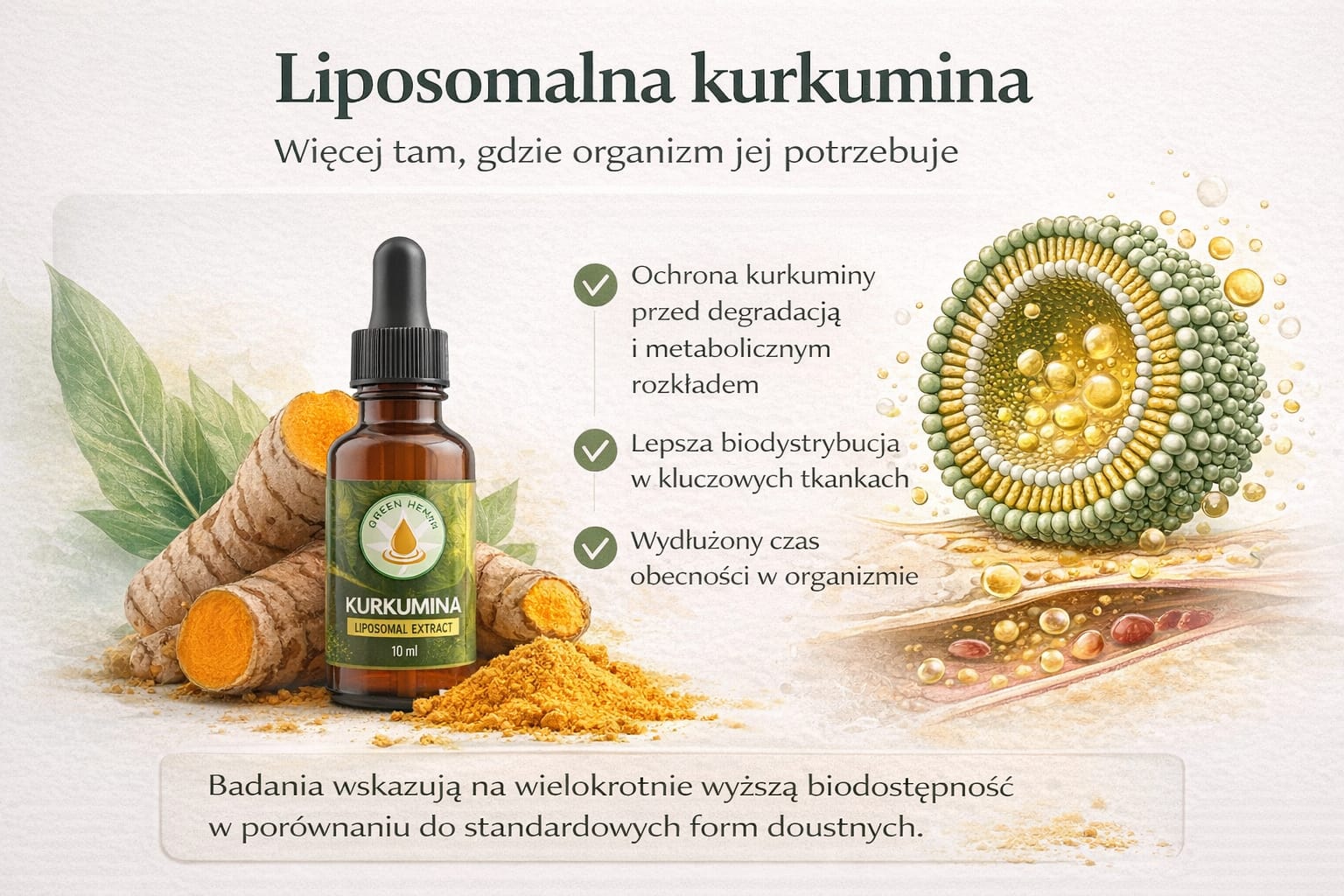
One example of the use of liposomal technology in practice is liposomal curcumin, which, due to the protection of the molecule and better biodistribution, allows for more stable and predictable biological activity at lower regular doses.
The use of this form is particularly important in long-term support of the body, where continuity of cellular exposure is crucial, rather than a short-term peak effect.
See product: Liposomal curcumin – liposomal extract
SOURCES (research)