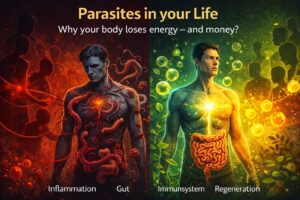


How do you find out if you have parasites? This question comes up more and more often for people who notice digestive problems, chronic fatigue, skin changes or other unusual symptoms. Parasites can go unnoticed for a long time, so it is important to know the signals that may indicate their presence in the body.
Parasites are organisms that live at the expense of their host, using its resources to survive and reproduce. In nature, they are a natural phenomenon and are found in almost every ecosystem. Contact with various microorganisms, including parasites, is part of the functioning of the natural environment.
For thousands of years, humans have been in contact with various forms of life present in the environment – in soil, water, plants or animal organisms. In most cases, the body copes with them through natural defense mechanisms, such as the immune system, the gut microbiome and the body’s protective barriers.
In recent years, the topic of parasites has increasingly come up in the context of human health. Many people wonder whether various non-specific symptoms – such as digestive problems, fatigue or skin changes – may be related to the presence of parasites in the body.
At the same time, it is worth remembering that similar symptoms can have very different causes. The human body is a complex biological system in which many processes affect the overall well-being and functioning of the entire body.
Therefore, the question of how to check whether one has parasites arises quite often in the context of searching for the causes of various ailments.
In this article, we will take a closer look at this:
Parasites have accompanied various living organisms for thousands of years. In the natural world, they are part of natural ecosystems and participate in many biological processes.
Humans, too, are in contact with various microorganisms present in the environment – in soil, water, food or animals.
In recent years, the topic of parasites has appeared more and more often in health articles. This is influenced by several factors.
First, there is growing interest in the functioning of the gut and the microbiome. A growing body of research indicates that the balance of microorganisms in the body can affect many aspects of health.
Second, more and more people are paying attention to the signals sent by the body and trying to understand the causes of various ailments.
At the same time, it is worth noting that the presence of parasites does not necessarily mean serious health problems, and many symptoms attributed to parasites may have completely different causes.
Therefore, this topic requires a calm and rational approach.
The question of how to find out if one has parasites usually arises when someone observes various non-specific symptoms in themselves.
In practice, there are several ways that can help assess the situation.
The most commonly discussed are:
Each of these elements can play a role in the diagnosis process.
Symptoms associated with parasites can vary widely. They largely depend on:
Symptoms that are sometimes discussed in the context of parasites include:
However, it is worth remembering that the same symptoms can be associated with many other factors, such as diet, stress, microbiome disorders or various chronic diseases.
Therefore, observation of symptoms should only be the first step in the process of finding the cause of health problems.
If the presence of parasites is suspected, one of the most important steps is to perform the appropriate tests.
The most common is laboratory testing, which can help detect some forms of parasites.
Stool testing is one of the basic tests used in the diagnosis of intestinal parasites. It involves the analysis of a stool sample in a laboratory.
In some cases, it is advisable to perform several tests on different days, as parasites may not always be present in every sample.
Depending on the situation, the doctor may also recommend other laboratory tests that help assess the functioning of the body.
Sometimes it is analyzed, among other things:
Such tests do not always detect parasites directly, but can provide additional information about the condition of the body.
The most important part of diagnosis is consultation with a doctor. A specialist can assess symptoms, order appropriate tests and help interpret the results.
Some complementary medicine practices also use methods known as bioresonance.
This approach is based on the premise that the organism and microorganisms can emit specific electromagnetic signals that can be analyzed by specialized equipment.
One of the systems used in such offices is BICOM, which has medical device status in many countries and is used in bioresonance therapy.
Proponents of this method point out that it can help analyze various stresses on the body and look for factors that affect its balance.
It is worth noting, however, that bioresonance is a complementary medicine method, and its interpretation depends on the experience of the therapist and the diagnostic approach adopted.
For this reason, the results of such analyses should be treated as part of a broader assessment of the body, rather than as the sole basis for diagnosis.
In practice, many people use both laboratory tests and various complementary methods to better understand how their bodies function.
One of the reasons why the subject of parasites can sometimes be difficult to clearly identify is their complex life cycle.
Many parasites undergo different stages of development, which can occur in different parts of the body or environment.
In addition, some parasites can expel their eggs at irregular intervals. This means that a single test may not always reveal their presence.
Another factor is that symptoms associated with parasites are often nonspecific and can resemble those of many other health problems.
In the context of parasites, the topic of natural ways to support the body also often comes up.
However, it is worth emphasizing that natural methods do not replace diagnosis or treatment recommended by a doctor. Instead, they can support the overall balance of the body.
In recent years, there has been growing interest in plant extracts used in various herbal traditions.
Plants such as:
have long appeared in herbal literature as part of supporting the body’s balance.
Modern approaches to supplementation are increasingly combining traditional herbal knowledge with modern extraction technologies.
One such technology is liposomal forms, in which plant ingredients are encapsulated in microscopic lipid structures called liposomes.
The purpose of such technology is to increase the stability of the ingredients and their bioavailability in the body.
More and more plant preparations prepared with liposomal technology are appearing on the market, which are being developed for high-quality extracts and modern forms of supplementation.
The digestive system is one of the most important systems in the human body. It is in the intestines that most of the processes involved in digestion and absorption of nutrients take place.
At the same time, the gut plays an important role in the functioning of the immune system.
It is estimated that a significant portion of the body’s immune cells are located right in the gut.
This is why many health articles emphasize the importance:
The question of how to check if one has parasites comes up quite often in the context of various health ailments.
In practice, the answer to this question requires consideration of several elements:
At the same time, it is worth remembering that many symptoms attributed to parasites may have other causes.
Therefore, the most important thing is to take a holistic approach to health and take care of the body’s balance.
If you’re interested in the topic of parasites and their effects on the body, it’s also worth exploring other articles discussing the issue more broadly.
1️⃣ Symptoms of parasites in humans
2️⃣ How parasite infection occurs – the most common routes of infection
3️⃣ Parasites and chronic fatigue – can they cause lack of energy?
4️⃣ Parasites and intestinal problems
5️⃣ Parasites and skin problems
6️⃣ Parasites and immunity
7️⃣ Human flukes – parasites of the liver and bile ducts



We use cookies to improve your experience on our site. By using our site, you consent to cookies.
Manage your cookie preferences below:
Essential cookies enable basic functions and are necessary for the proper function of the website.
These cookies are needed for adding comments on this website.
Google Tag Manager simplifies the management of marketing tags on your website without code changes.
Statistics cookies collect information anonymously. This information helps us understand how visitors use our website.
Google Analytics is a powerful tool that tracks and analyzes website traffic for informed marketing decisions.
Service URL: policies.google.com (opens in a new window)
SourceBuster is used by WooCommerce for order attribution based on user source.