
You wake up in the morning and, in theory, everything should work.
You slept.
You ate.
You drank the coffee.
And yet something is not right.
Thinking is slower.
Concentration falls apart.
Lacks energy for simple things.
You begin to wonder:
Is it fatigue?
or stress?
Or just “that kind of day”?
The problem is that if this condition begins to recur, it is very often no longer a matter of a temporary drop in form.
This could be a signal that something deeper is going on in the body.
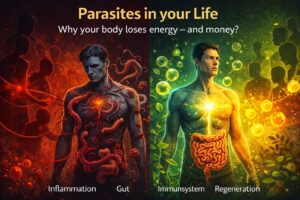
One of the most often overlooked elements is precisely inflammation.
And not in the sense of acute infection.
But as a process that can affect brain function, energy levels and the ability to concentrate.
You know that moment when you want to focus, you have the time, you have the conditions, nothing distracts you – and yet something doesn’t work?
You read a sentence and after a while you can’t remember the beginning.
You go back. You try again.
Thoughts run away.
From the outside, everything looks fine:
you’re sleeping, drinking coffee, trying to get organized, doing what “should work.”
And yet:
At this point, most people look for the problem in the head.
But very often the problem starts elsewhere.
In the gut.
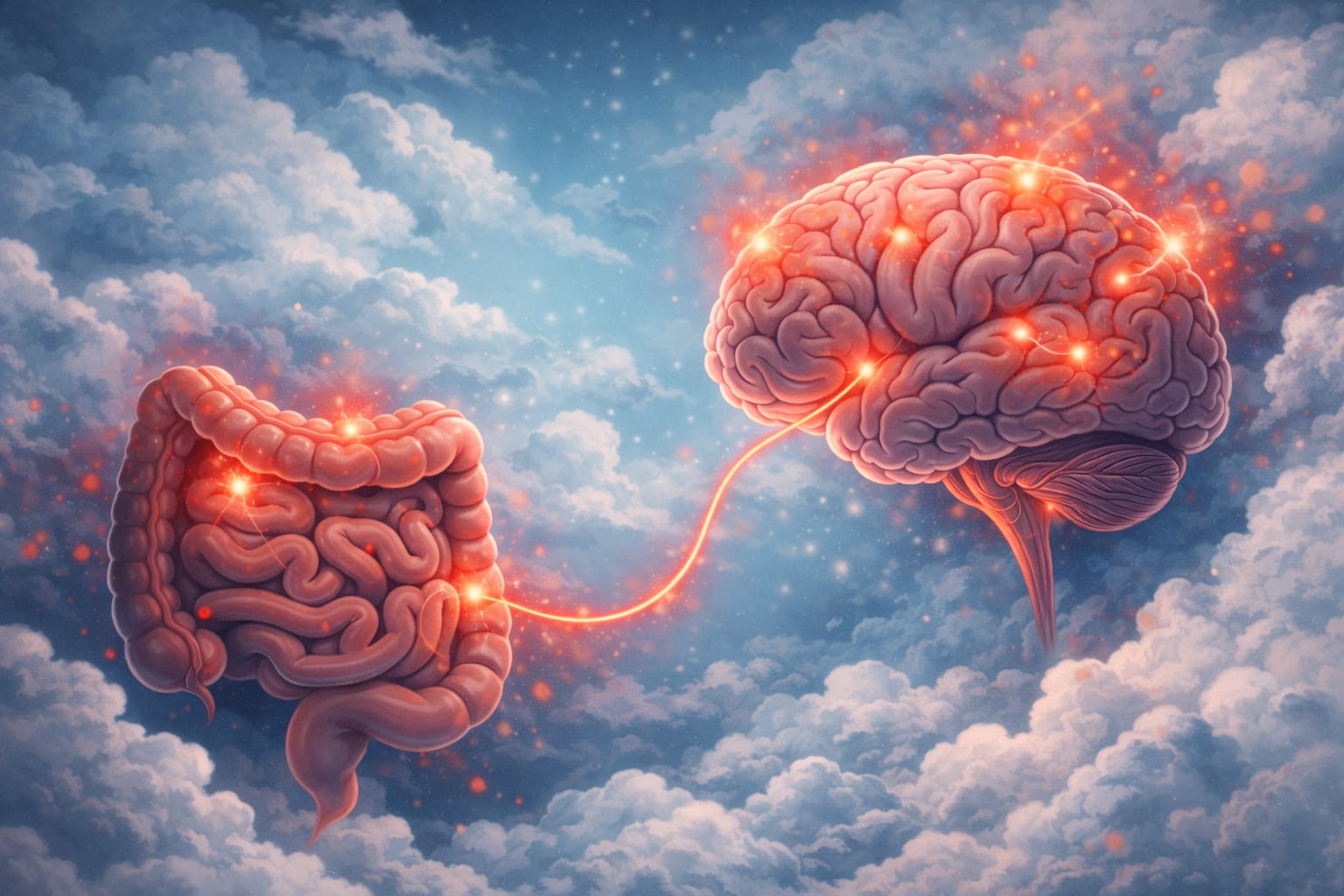
The gut-brain axis is the connection between the digestive system and the brain.
This is not a metaphor. It’s real, physical communication that works all the time.
The intestines and the brain are connected:
This means one thing:
What happens in the gut doesn’t stay in the gut.
It directly affects how your brain works.
Many people treat the gut as something simple:
food goes in → is digested → the end.
But the reality is quite different.
The intestines are:
And most importantly:
is one of the main sites regulating the environment in which the brain operates.
If this environment is disturbed – the brain begins to work differently.
It’s not one mechanism.
It’s several processes that work simultaneously.
There is a direct nerve connection between the gut and the brain.
Signals are transmitted both ways:
This means that the condition of the gut can affect:
The intestines affect what goes into the blood.
If they function properly:
the body gets what it needs.
If not:
disorders appear.
And this directly affects the brain, which is very sensitive to changes in the environment.
Much of the immune system is related to the gut.
If there is a problem in the gut:
the body reacts.
And this changes the way the whole system works.
This includes the brain.
When the intestines are not functioning optimally:
the body enters a state of overload.
It doesn’t have to be something harsh.
It could be:
The result?
The brain begins to work less efficiently.
It appears:
This is not a lack of discipline.
It’s a change in the conditions under which the brain works.
Many people describe their condition as:
“I have a fog in my head.”
This is a very apt term.
Because it’s not about the lack of thinking.
It’s about its quality.
Thinking becomes:
And it’s very often related to what’s going on in the gut.
The body works as a system.
If one element is overloaded:
it affects the whole.
Intestines that are not functioning properly:
The result?
Less energy for the brain.
And without energy:
there is no concentration.
This is one of the most visible symptoms.
It’s still ok in the morning.
Then there is a decline.
In the afternoon, fatigue.
In the evening, sometimes a sudden “comeback”.
This is not always due to the mode of the day.
Often this is a result of how the body handles the load.
And the gut plays a big role in this.
This is a moment that many people notice.
To begin with:
coffee works.
Then:
runs shorter.
Later:
hardly at all.
Or it works, but causes an even greater decline later.
Why?
Because coffee doesn’t solve the problem.
She only temporarily changes the state.
If the body is overloaded (for example, by the intestines):
the effect will be limited.
They are not always obvious.
But they often appear together:
Many people treat them separately.
And this is often one mechanism.
Because it is not addressed at the source.
Instead:
But that doesn’t change the basis.
That’s why the problem is coming back.
Not right away.
First:
the body is stabilizing
Then:
energy stops falling so sharply
Next:
concentration begins to return
It’s a process.
And trying to speed it up often ends up backfiring.
Because concentration is not just a “skill.”
This is a result of how the whole body works.
If you only look at the brain:
you see a fragment.
If you look more broadly:
you begin to understand the mechanism.
Not from complicated solutions.
From the ground up:
This creates conditions in which the body can return to balance.
Problems with concentration, energy and clarity of thought are very rarely due to a single cause. Most often, they are the result of how the whole body functions – and the gut-brain axis plays a key role in this process. What happens in the gut affects the brain’s working environment, and thus your daily productivity, focus and mood. Understanding this mechanism allows you to take a broader view and stop focusing solely on symptoms and start working at the root.
if you want to know what to do about it in practice – in the next article we are already moving to concrete actions and solutions.




We use cookies to improve your experience on our site. By using our site, you consent to cookies.
Manage your cookie preferences below:
Essential cookies enable basic functions and are necessary for the proper function of the website.
These cookies are needed for adding comments on this website.
Google Tag Manager simplifies the management of marketing tags on your website without code changes.
Statistics cookies collect information anonymously. This information helps us understand how visitors use our website.
Google Analytics is a powerful tool that tracks and analyzes website traffic for informed marketing decisions.
Service URL: policies.google.com (opens in a new window)
SourceBuster is used by WooCommerce for order attribution based on user source.