
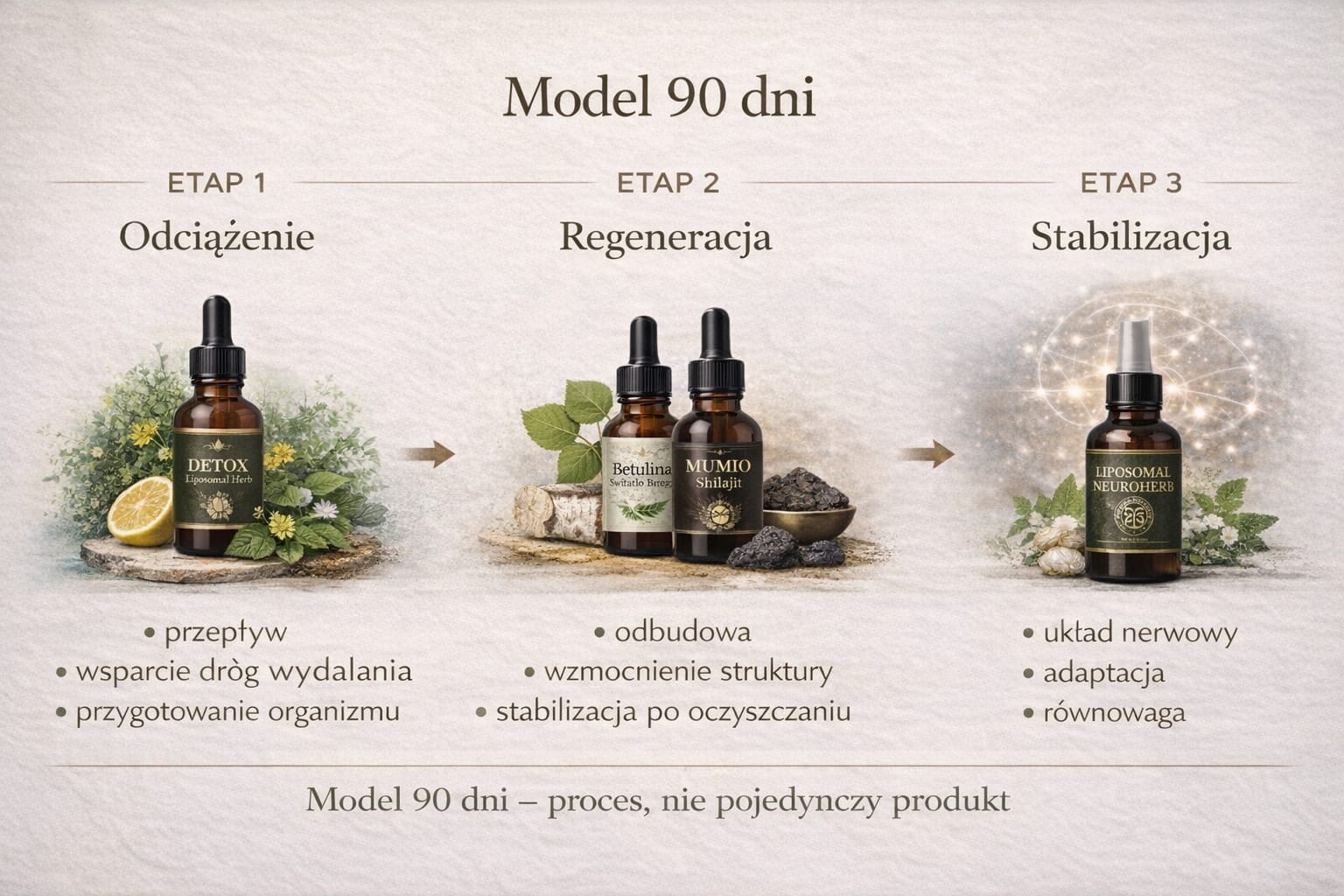
The 90-day model is a structured approach to the process of stress relief, recovery and stabilization of the body.
We don’t start with “killing.”
We don’t start with aggression.
We start with restoring flow.
An overloaded body does not need strength first.
It needs permeability.
This model is an orderly process of three stages:
Every stage has its place.
Every stage has its logic.
The first month is about working on:
If the excretion pathways are blocked,
if bile is thick,
if peristalsis is slowed,
Any stronger action can be counterproductive.
Therefore, the first stage is:
Depending on body weight and load level
sometimes one bottle of formula is enough,
and sometimes the stage needs to be extended.
It’s not about speed.
It’s about efficiency.
Once the flow has been restored,
we enter the recovery phase.
This stage focuses on:
Betulin and Mumio in this model are not the “aggressor.”
They are a means of restoring balance.
The body needs rebuilding after relieving stress.
Without this, we enter a spiral:
detox → weakness → another detox.
It’s not a sprint.
It’s a process.
The third stage is to work on:
If someone is taking medication or has severe nervous system tension,
this stage can be introduced earlier.
Sometimes it is the nerve regulation
that allows the body to enter the relief process at all.
The liposomal form allows support through the mucosa,
which in practice means:
This is not magic.
This is physiology in practice.
Because the biological process takes time.
Change:
doesn’t happen in a week.
90 days are:
For people who:
This is not a “special operation.”
This is an orderly model of operation.
You can:
The body does not function in “on/off” mode.
Adaptation processes occur sequentially and require specific environmental conditions.
If at the stage of metabolic overload we begin to stimulate the body intensively, we can exacerbate instability instead of extinguishing it.
On the other hand, remaining in the reduction phase for too long without transitioning to recovery can lead to a weakening of energy reserves.
The stage model takes into account the natural logic of physiology:
This reflects how the body itself goes through repair processes after overload.
Relief does not mean aggressive “cleaning.”
It means reducing the factors that sustain a state of overload.
At the biological level, this may include:
– reduction of oxidative stress,
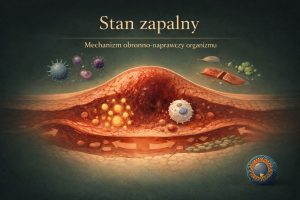
– regulation of the inflammatory response,
– support of the liver’s natural detoxification mechanisms,
– improvement of sleep conditions and nighttime recovery.
The goal is not to fight the organism, but to create conditions in which it can restore the signal balance.
After reducing the overload, the body needs time and energy to rebuild.
At this stage, the key factors are:
– mitochondrial functions (ATP production),
– redox balance,
– restoration of gut microbiota,
– normalization of neurotransmitter levels.
Regeneration is not instantaneous.
It is a process that requires stable environmental conditions and consistency.
Stabilization means that the body regains the ability to respond flexibly to stimuli.
At the physiological level, this includes:
– regulation of the stress axis (HPA),
– improvement of sleep quality and diurnal rhythm,
– stabilization of mood and cognitive function,
– reduction of inflammatory hyperreactivity.
Only in this phase can one speak of a more complete recovery.
Cellular processes, especially those related to the remodeling of the metabolic environment, take time.
The cycle of renewal of many cells, mitochondrial adaptation or regulation of hormonal axes do not occur in a few days.
A period of about three months allows to go through:
– reduction phase,
– reconstruction phase,
– adaptive stabilization phase.
This is not a rigid time limit, but an approximate period in which the body can go through a more complete regulatory cycle.
The choice is yours.
The process remains the same.
You don’t have to put it together yourself – Full Set Program 90 days guides you through the entire process step by step.







We use cookies to improve your experience on our site. By using our site, you consent to cookies.
Manage your cookie preferences below:
Essential cookies enable basic functions and are necessary for the proper function of the website.
These cookies are needed for adding comments on this website.
Google Tag Manager simplifies the management of marketing tags on your website without code changes.
Statistics cookies collect information anonymously. This information helps us understand how visitors use our website.
Google Analytics is a powerful tool that tracks and analyzes website traffic for informed marketing decisions.
Service URL: policies.google.com (opens in a new window)
SourceBuster is used by WooCommerce for order attribution based on user source.