

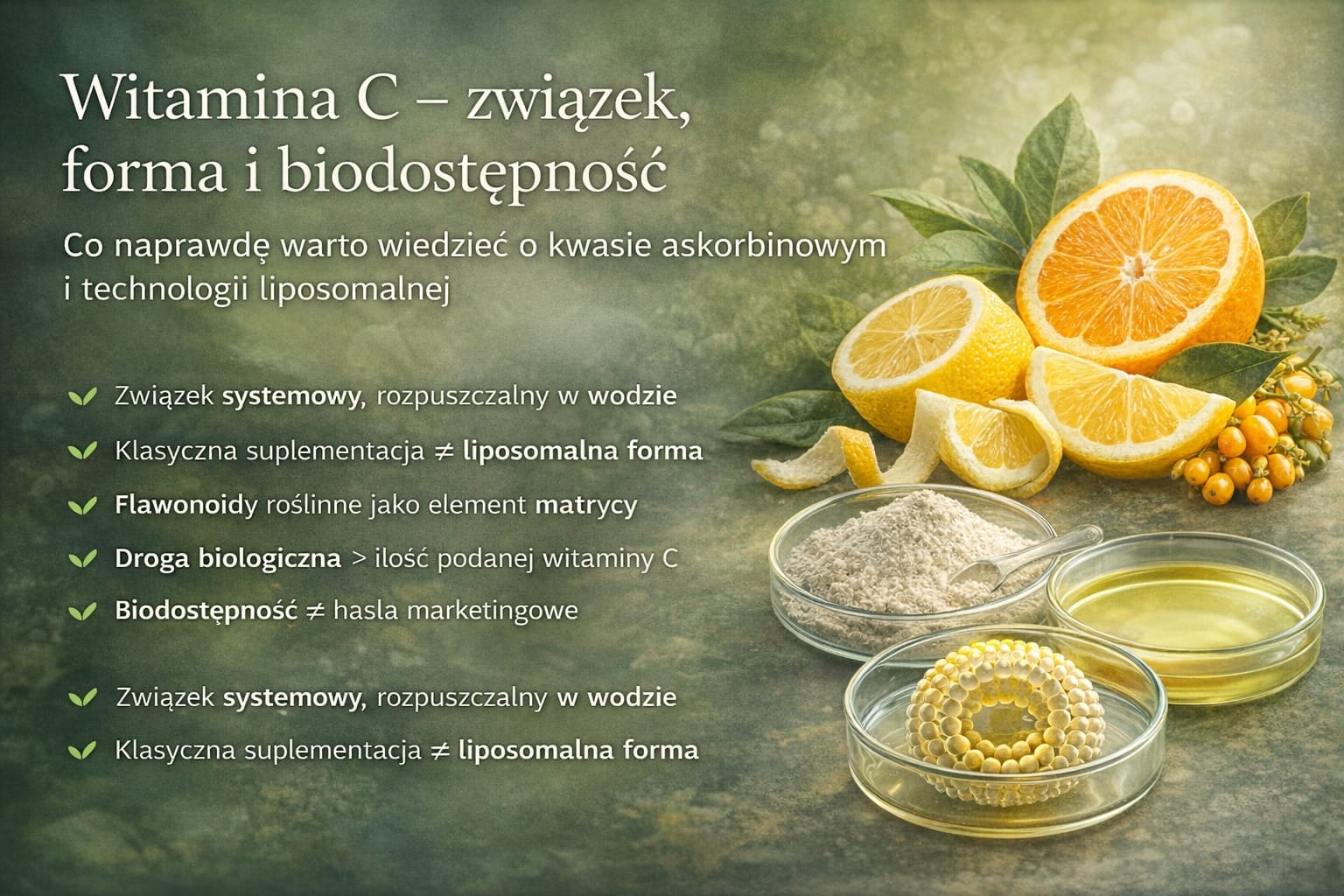
Vitamin C is one of the best-studied biologically active compounds, whose bioavailability depends on the form of administration.
Vitamin C (L-ascorbic acid) is one of the best known and at the same time most often simplified biologically active compounds. Although it has been present in the scientific literature for decades, its actual action in the human body is still sometimes reduced to acronyms and simplistic narratives.
This article is intended to educate and organize knowledge. Its purpose is to explain:
Vitamin C, or L-ascorbic acid, is a low-molecular water-soluble compound that, in humans, must be supplied externally. Unlike most mammals, the human body does not synthesize vitamin C endogenously.
Biologically, vitamin C has a role:
Its importance is not limited to one system – it is a systemic relationship.
Although vitamin C is sometimes described as an antioxidant, its role is more complex. In biology:
It’s not just about neutralizing free radicals, but about maintaining the dynamic oxidative balance necessary for proper cell function.
Vitamin C is often linked to immunity, but its effects:
For this reason, its role is particularly important in states of long-term stress on the body.
Ascorbic acid in the classic oral form is characterized by:
This means that increasing the dosage does not translate linearly into increased levels of vitamin C in cells.
In biology, more than that is crucial:
how much of the compound we take in,
but most importantly:
inwhat form and by what route it reaches the cells.
In the case of vitamin C, differences between forms of administration lead to completely different biological profiles.
Liposomal technology involves encapsulating the active molecule in a lipid structure made of phospholipids, which resemble natural cell membranes.
In the case of vitamin C, this means:
Compared to classical forms, vitamin C in liposomal technology:
It is not a “stronger” vitamin C – it is the same molecule in a different biological pathway.
In the environment, vitamin C almost never occurs in isolation. It is accompanied by various groups of plant compounds, including flavonoids, which co-form a natural biological matrix.
Flavonoids are being studied in the context of their effects on ascorbic acid stability, oxidation-reduction processes and protection against its premature oxidation.
For this reason, modern formulations increasingly include the presence of flavonoids as part of the biological context, rather than as a separate “active ingredient.”
Some liposomal preparations use plant-derived flavonoids, including those from hemp, as a complementary element in the matrix of compounds accompanying vitamin C.
Product descriptions are subject to a specific legal framework. For this reason:
Therefore, educational articles are a necessary complement to product information.
In biological practice, vitamin C:
Its meaningful use is to fit it into the body’s process of regulation and adaptation, taking into account form, quality and regularity.
Vitamin C is:
Understanding its role requires moving away from simple slogans and focusing on:
For a more extensive discussion of the mechanisms behind the liposomal form, see the paper on liposomal technology.
Therefore, in the modern approach, it is not “how much” but “how” that is increasingly important.
Examples of the use of liposomal technology in vitamin C preparations:
Liposomal Vitamin C






We use cookies to improve your experience on our site. By using our site, you consent to cookies.
Manage your cookie preferences below:
Essential cookies enable basic functions and are necessary for the proper function of the website.
These cookies are needed for adding comments on this website.
Google Tag Manager simplifies the management of marketing tags on your website without code changes.
Statistics cookies collect information anonymously. This information helps us understand how visitors use our website.
Google Analytics is a powerful tool that tracks and analyzes website traffic for informed marketing decisions.
Service URL: policies.google.com (opens in a new window)
SourceBuster is used by WooCommerce for order attribution based on user source.