
Unlike many other parasites, flukes often develop very slowly. For this reason, infection can go unnoticed for a long time. In many cases, the presence of parasites is not detected until years later, when more pronounced symptoms related to the functioning of the liver, intestines or immune system appear.
The article takes a closer look at this:
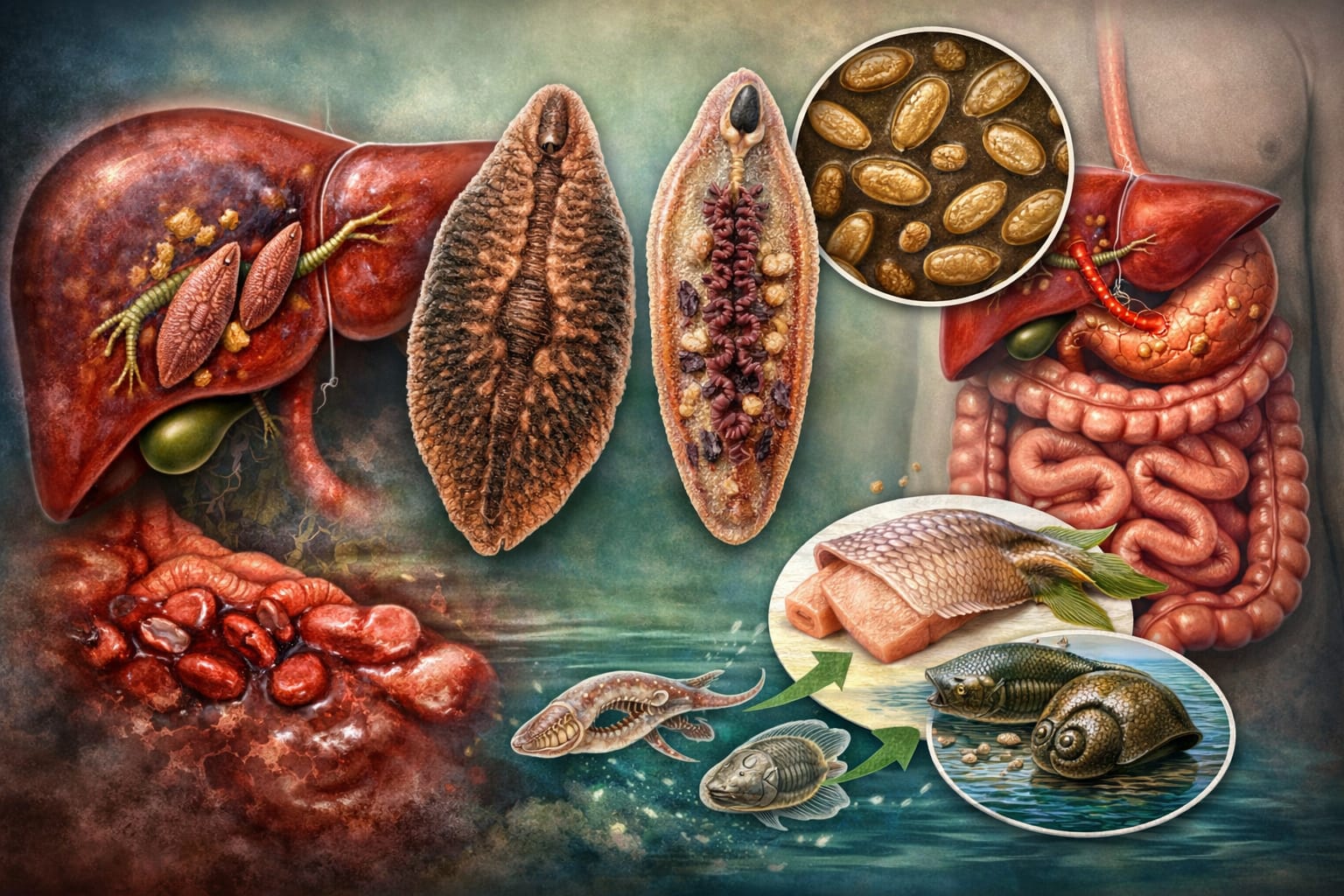
The flukes belong to the group of parasitic flatworms (Trematoda). They are organisms with a flattened, often leaf-shaped body, equipped with characteristic suckers that enable them to attach themselves to host tissues.
The life cycle of most flukes involves several developmental stages and at least one intermediate host, which is most often a snail.
Characteristics of flukes:
The flukes can inhabit a variety of tissues, but in humans they are most commonly found in:
One of the most well-known species. It parasitizes mainly in the bile ducts of the liver.
Infection usually occurs through ingestion:
The species is found mainly in Asia. Infection occurs by eating raw or undercooked freshwater fish.
The parasite inhabits the bile ducts and can remain in the body for many years.
It is mainly found in Eastern Europe and Asia.
The source of infection is usually freshwater fish consumed raw or undercooked.
Parasite infection usually occurs through contact with water or food containing the larval stages of the parasites.
The most common routes of infection are:
In many cases, the infection occurs unnoticed.
One of the most distinctive features of flukes is their ability to survive in the host for long periods of time.
Depending on the species of the parasite, this time can be:
Such a long life span is made possible by the parasites’ ability to:
Many parasitic infections develop slowly. The flukes often function in the body for a long time without obvious symptoms.
The reasons vary:
For this reason, many people are unaware of the presence of parasites for years.
Symptoms can be varied and depend on many factors:
Symptoms described in the literature include:
These symptoms are nonspecific and can have many different causes.
Diagnosing a parasitic infection can be difficult and often requires several diagnostic methods.
The most commonly used are:
Some centers also use bioresonance, an analysis of the body’s response to specific electromagnetic signals.
One of the systems used in complementary medicine is BICOM, developed in Germany. This class of equipment has medical certification and is used in many offices in Europe.
Bioresonance diagnostics involves analyzing the body’s response to specific frequency patterns associated with various microorganisms.
This method is sometimes used as a complementary tool to take a broader look at the functioning of the body.
A growing body of research indicates that parasites are strongly dependent on the host’s biological environment.
Significance includes:
Therefore, the literature also analyzes the effects of various plant substances on these processes.
Many plant substances are being analyzed in scientific studies, including:
Relationships that appear in the literature include:
These substances are analyzed for their effects on the body’s biological environment.
One of the challenges associated with many plant substances is their bioavailability.
Part of the relationship:
Therefore, increasing attention is being paid to technologies that increase bioavailability, such as liposomal systems.
Parasites are parasites with a very complex life cycle and high adaptability to the host environment. Depending on the species, they can colonize different tissues of the body and remain there for many years.
Infections with these parasites are often difficult to detect, as symptoms can be nonspecific and develop slowly.
For this reason, the diagnosis of flukes is usually based on a combination of several methods, including both laboratory tests and various forms of functional diagnostics.
Yes, some species of flukes can stay in the human body for a very long time. The scientific literature describes cases in which parasites such as Clonorchis sinensis or Opisthorchis persisted in the body for up to 20-30 years. This is possible due to the parasites’ ability to adapt to the host environment and partially evade the immune system’s response.
Most often, the flukes inhabit:
Some species can also be found in other tissues, including blood vessels or the lungs. The location of the parasite depends on its species and developmental stage.
Parasite infection most often occurs through:
In many cases, the infection occurs unnoticed.
Symptoms can vary and are often nonspecific. Among others, the literature describes:
However, similar symptoms can have many different causes, so they always require a broader diagnosis.
Yes. Parasite infections can be difficult to detect because the parasites often develop slowly and may not cause clear symptoms for a long time. Therefore, diagnosis usually involves several methods, such as laboratory tests, diagnostic imaging and functional methods.
Various methods are used in the diagnosis of flukes, including:
Some centers also use bioresonance diagnostics with systems such as BICOM, which are medically certified and used in complementary medicine.
A growing body of research indicates that parasites function in close dependence on the host’s biological environment. Significance may include:
For this reason, the literature also analyzes the effects of various plant substances on these processes.
Yes. Many plant compounds, including polyphenols, anthraquinones or plant alkaloids, are being analyzed in scientific research. Compounds present in plants such as Japanese knotweed are being studied for their effects on the body’s biological environment, inflammatory processes and microbial balance.
If you are interested in the topic of parasites and their effects on the body, it is also worth reading the other articles in this series, which discuss, among other things, the symptoms of the presence of parasites, the pathways of infection and their potential impact on various body systems.
1️⃣ Symptoms of parasites in humans
2️⃣ How parasite infection occurs – the most common routes of infection
3️⃣ Parasites and chronic fatigue – can they cause lack of energy?
4️⃣ Parasites and intestinal problems
5️⃣ Parasites and skin problems
6️⃣ Parasites in your life
7️⃣ How to find out if you have parasites – symptoms and tests
.
If this topic is important to you
Leave your email – I’ll let you know when there are new articles
and materials on the site.
No spam. Only valuable content.



We use cookies to improve your experience on our site. By using our site, you consent to cookies.
Manage your cookie preferences below:
Essential cookies enable basic functions and are necessary for the proper function of the website.
These cookies are needed for adding comments on this website.
Google Tag Manager simplifies the management of marketing tags on your website without code changes.
Statistics cookies collect information anonymously. This information helps us understand how visitors use our website.
Google Analytics is a powerful tool that tracks and analyzes website traffic for informed marketing decisions.
Service URL: policies.google.com (opens in a new window)
SourceBuster is used by WooCommerce for order attribution based on user source.