

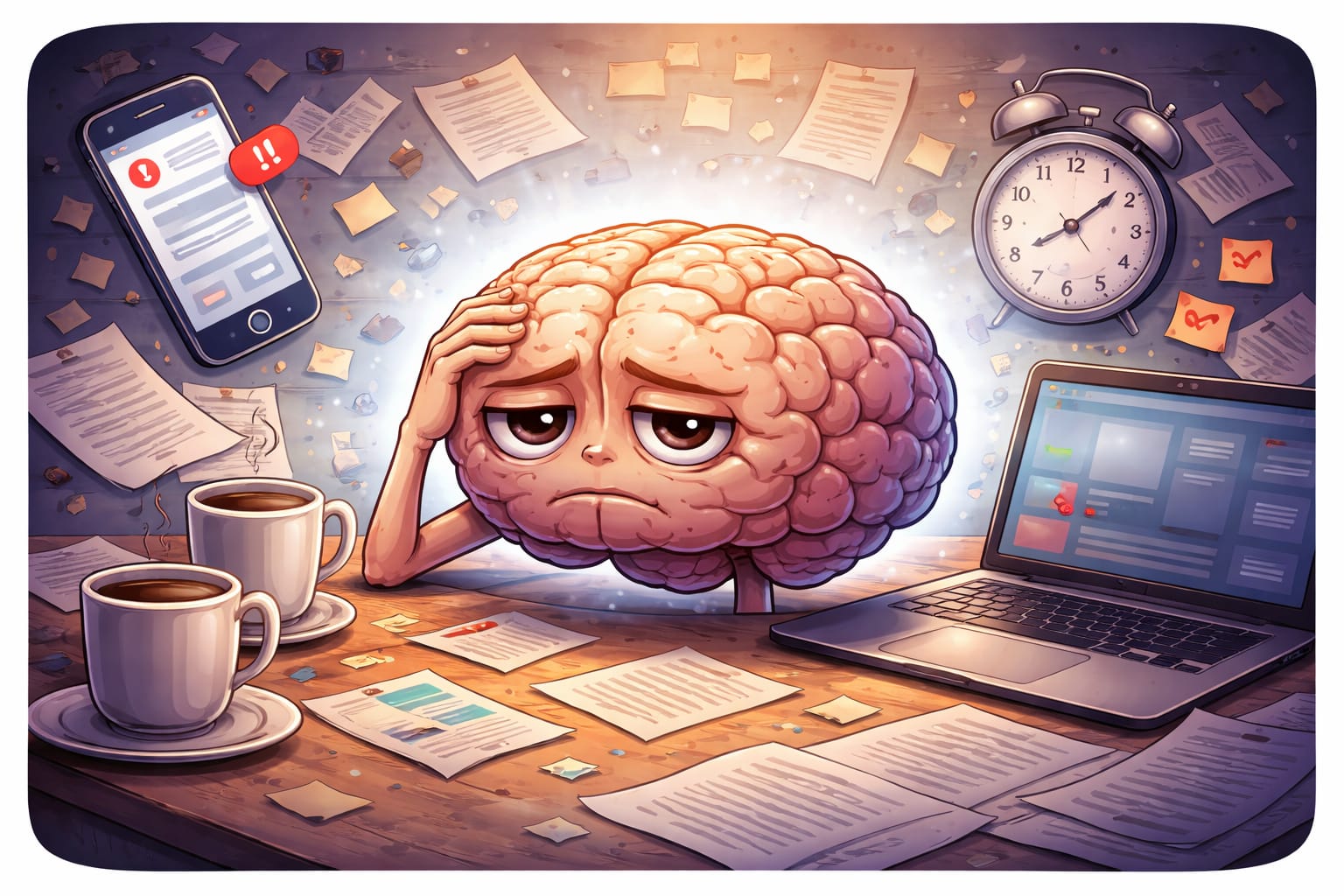
Loss of concentration is a problem that more and more people are facing today – even if everything seems fine at first glance.
You open the article, start reading – and after a while you catch yourself thinking somewhere else entirely. You go back to the beginning, try again… and it’s the same thing again.
You have the time. You have the conditions. No one bothers you.
And yet you are unable to go into deep concentration.
It’s not a lack of discipline.
And it’s not a matter of “not trying hard enough.”
In fact, loss of concentration is often due to the fact that the brain stops working in an optimal mode and begins to operate more superficially.
And this is a moment that many people ignore.
Because instead of understanding the cause, they try to force themselves to do more.
In a moment, you’ll see what really affects concentration and why it becomes harder and harder to focus over time – even on simple things.
Lack of concentration doesn’t just mean that you can’t focus.
It’s a state in which the entire thinking process begins to work less efficiently.
It can manifest itself in different ways:
Many people try to solve this by force of will.
But concentration is not just a function of character or motivation.
This is a result of what state the nervous system, energy levels and overall body condition are in.
If any of these elements starts to go awry, the concentration shows it very quickly.
This is one of the biggest myths.
When concentration drops, a thought automatically arises:
“I need to do better”
“I need to mobilize”
“I need to embrace”
Except that it works the other way.
If the brain doesn’t have the conditions to work, increasing effort leads to even more overload.
Instead of improvement it appears:
It’s a bit like trying to speed up a car that has an empty tank.
You can push the gas pedal, but without fuel nothing will change.
Most often, there is no one specific cause.
Rather, it is the result of several factors that are gradually beginning to accumulate.
Among the most common are:
Each of these elements separately may seem harmless.
But together they create an environment in which the brain has no space to work stably.
And importantly – this does not happen suddenly.
First there is a slight distraction.
Then it gets harder and harder to focus.
And at some point even simple things start to require effort.
One of the biggest problems with the modern lifestyle is the amount of stimuli.
Phone, notifications, social media, constant switching between tasks.
The brain was not designed to work in such a mode for many hours a day.
Each switch of attention:
Over time, you go into mode:
And even if you want to focus, the body is no longer prepared to do so.
This is one of the key elements.
Concentration is not just a matter of attention.
This is the effect of available energy.
The brain uses huge amounts of energy – especially when analyzing, making decisions and focusing for a long time.
If that energy starts to run out:
This is a natural mechanism.
The body begins to conserve resources where it can.
And one of the first areas to lose out on this is precisely concentration.
Many people are trying to solve this problem by increasing pressure.
More coffee.
More pressure.
More trying to force yourself to act.
And it works … very briefly.
Then comes the decline.
Even more fatigue.
Even more distraction.
A cycle is forming:
And over time, this cycle begins to repeat itself more and more often.
This is the moment that many people find most incomprehensible.
You rest. You sleep. You take a break.
And yet the concentration is not returning.
Why?
Because the problem often does not lie only in fatigue.
It may be about deeper overload:
It’s a bit like a computer that runs slowly not because it’s been on too long, but because it has too many processes running in the background.
Rest alone helps, but does not always solve the problem.
This is not a quick process.
Most often it looks gradual:
Many people expect an immediate effect.
And when he’s gone, he reverts to old patterns:
More stimulation, more pressure, more attempts to “push”.
Meanwhile, real improvement begins when the body begins to return to balance.
Because more often than not, we only change the symptom.
For a while we improve the focus, but then we go back to:
And the whole process begins again.
Therefore, concentration is not something that can be “fixed once.”
It’s a state that needs to be maintained.
Instead of looking for quick fixes, it’s worth going back to basics.
The biggest impact is:
This is the foundation.
Without it, everything else works only temporarily.
Lack of concentration is very rarely a problem in itself.
Most often it is a signal that something deeper in the body needs attention.
One of the key elements is energy – where the brain gets it from and why it starts to run out.
In the next article we will go into this in detail:
Why coffee stops working and where the lack of energy comes from
If this topic is important to you
Leave your email – I’ll let you know when there are new articles
and materials on the site.
No spam. Only valuable content.



We use cookies to improve your experience on our site. By using our site, you consent to cookies.
Manage your cookie preferences below:
Essential cookies enable basic functions and are necessary for the proper function of the website.
These cookies are needed for adding comments on this website.
Google Tag Manager simplifies the management of marketing tags on your website without code changes.
Statistics cookies collect information anonymously. This information helps us understand how visitors use our website.
Google Analytics is a powerful tool that tracks and analyzes website traffic for informed marketing decisions.
Service URL: policies.google.com (opens in a new window)
SourceBuster is used by WooCommerce for order attribution based on user source.