
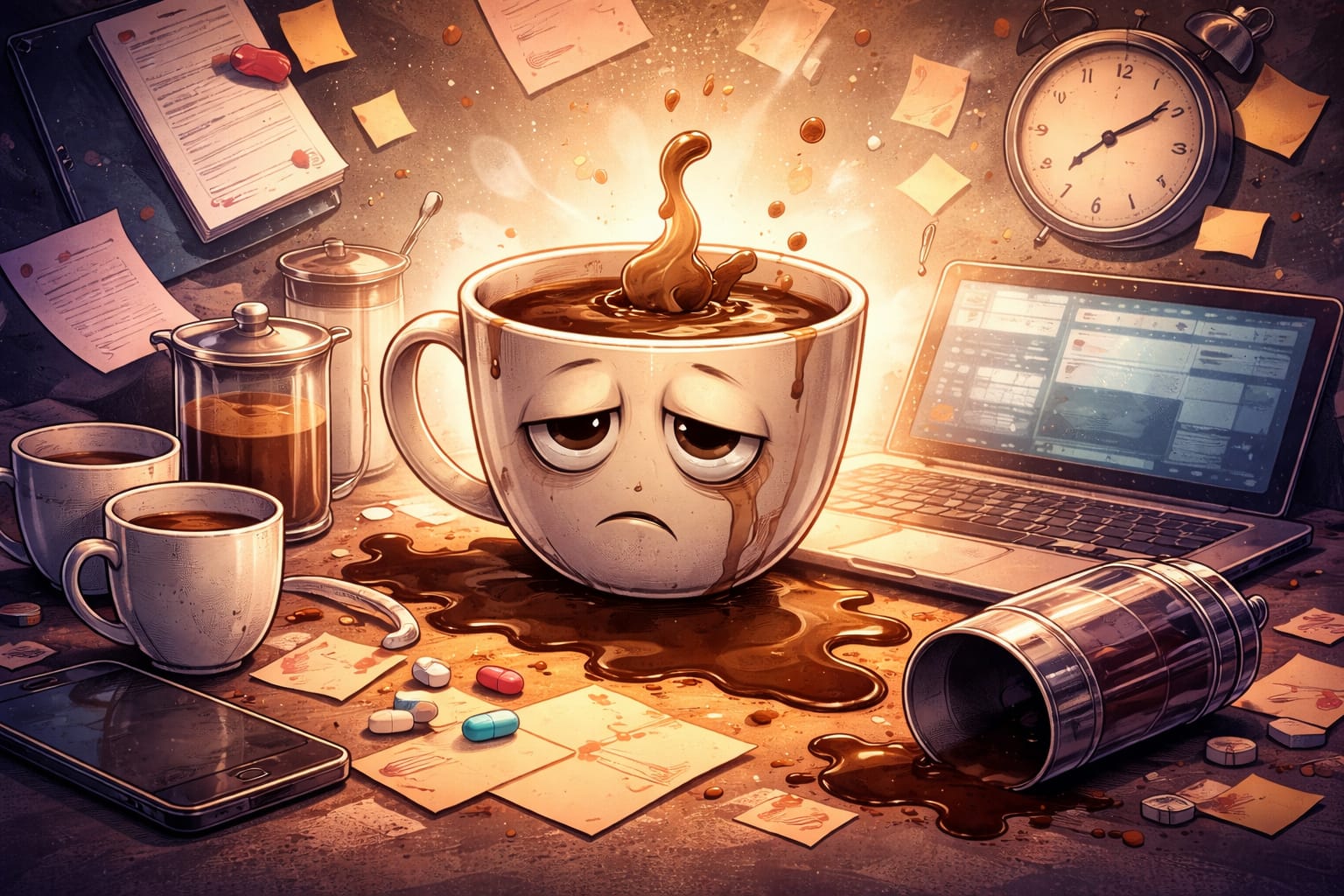
Until a while ago, one cup was enough and everything was back in place.
Better focus. More energy. Clarity of thought.
Now?
You drink coffee… and nothing changes.
Or it works for a while, and then an even bigger drop appears.
You begin to wonder:
Is it fatigue?
Is the body “used to it”?
Or do you just need more?
And then there is usually a natural reaction:
another coffee.
The problem is that this doesn’t solve the cause.
And often makes it even worse.
Coffee does not give energy in the way most people think.
It does not “add” to the body.
She works by affecting the nervous system – mainly by blocking fatigue signals.
In practice, this means one thing:
Coffee does not remove fatigue
only masks it for a while
It works very well at first.
The body still has resources, so after stimulation you are able to enter a higher level of performance.
But over time, the situation is changing.
If you have been functioning in the mode for a long time:
then the body begins to adapt.
And at some point it’s no longer about lack of motivation.
It’s all about lack of resources.
When the nervous system is overloaded and regeneration is insufficient:
And then the coffee stops working as before.
This is the point at which many people get trapped.
Since one coffee doesn’t work → we drink two.
If two don’t work → we drink three.
For a while there may be an effect.
But over time:
This leads to a pattern:
And so on and so forth.
Many people are experiencing the same thing:
After coffee there is energy…
and then a sudden drop.
This is what is known as a “crash”.
It manifests itself as:
Why is this happening?
Because the body did not receive real energy – only a signal to act.
And when this effect disappears, it returns to the state it was in before.
Sometimes even lower.
This is a key moment to understand.
Energy is not just a “feeling.”
This is a real process in the body.
And a very large part of this energy is managed by the nervous system.
If the nervous system is:
then even if you try to stimulate yourself – the effect will be limited.
Because the system that manages energy is not working properly.
This is one of the most common questions.
You sleep.
You rest.
And yet you have no energy.
Why?
Because sleep is only one part of recovery.
If during the day the body is:
is the sheer amount of sleep is not always enough.
The regeneration must be complete, not just “fleshed out.”
It is worth distinguishing between two things:
Fatigue and overload.
Fatigue is a condition that passes after rest.
Overload is a condition that persists despite recovery attempts.
And it is the overload that is most often behind it:
The less energy you have, the more you try to “force” it.
More coffee.
More stimulation.
More pressure.
But this only works in the short term.
In the long run, it leads to:
It’s a closed cycle that drives itself.
It’s a natural adaptation.
The body does not want to be stimulated all the time.
If it gets a stimulation signal too often:
is starting to become immune to it
The result?
This is not a coffee problem.
It is the body’s reaction to the way it is used.
This is the most important question.
Because if coffee stops working, it means you have to go back to basics.
Real energy results from:
These are not “extras.”
This is the foundation.
This is not a sudden jump.
It’s a process.
Most often it looks like this:
And importantly – this stimulation is not “artificial.”
There are no sharp ups and downs.
It is stable.
Because they work on the symptom, not the cause.
Coffee can help for a while.
But if the problem lies deeper, then:
That’s why it’s so important to understand that lack of energy is not something that can be “fixed in one way.”
If you notice that the coffee stops working, it is not a coffee problem.
It’s a signal.
A signal that the body needs more than stimulation.
In the next article, we will turn to one of the key elements that affects both energy and concentration: Inflammation – what is it and how does the body maintain balance?
And if you want to see the whole process and understand how to restore focus and energy step by step – you can find it here: How to restore focus and energy? The regenerative process .
If this topic is of interest to you
Leave your email – I’ll let you know when there are new articles
and materials on the site.
No spam. Only valuable content.



We use cookies to improve your experience on our site. By using our site, you consent to cookies.
Manage your cookie preferences below:
Essential cookies enable basic functions and are necessary for the proper function of the website.
These cookies are needed for adding comments on this website.
Google Tag Manager simplifies the management of marketing tags on your website without code changes.
Statistics cookies collect information anonymously. This information helps us understand how visitors use our website.
Google Analytics is a powerful tool that tracks and analyzes website traffic for informed marketing decisions.
Service URL: policies.google.com (opens in a new window)
SourceBuster is used by WooCommerce for order attribution based on user source.