
Symptoms of parasites are often not clear-cut. In many cases they are chronic and confused with other problems.
The most commonly observed signals are:
In practice, this means that the body functions in overload mode for a long time, even if there are no acute disease symptoms.
Most people don’t connect one with the other – and lack of energy very often costs real money.
Money is the result of action – and action starts with energy.
If you have less of it, you act slower, postpone decisions, concentrate less well and in the long run lose not only your strength, but also your real opportunities and earnings.
It is not always immediately apparent, but lack of energy very often translates into concrete losses.
It’s not a matter of motivation.
It’s a matter of what’s realistically going on in the body – often beyond your awareness.
In this article you will see why this happens, how this mechanism works in practice, and what may be one of the hidden causes that takes energy for a long time before you even notice it.
To understand this, you have to see what’s going on deeper – in the body itself.
The body doesn’t lose energy for no reason – there is always something that is constantly stressing it.
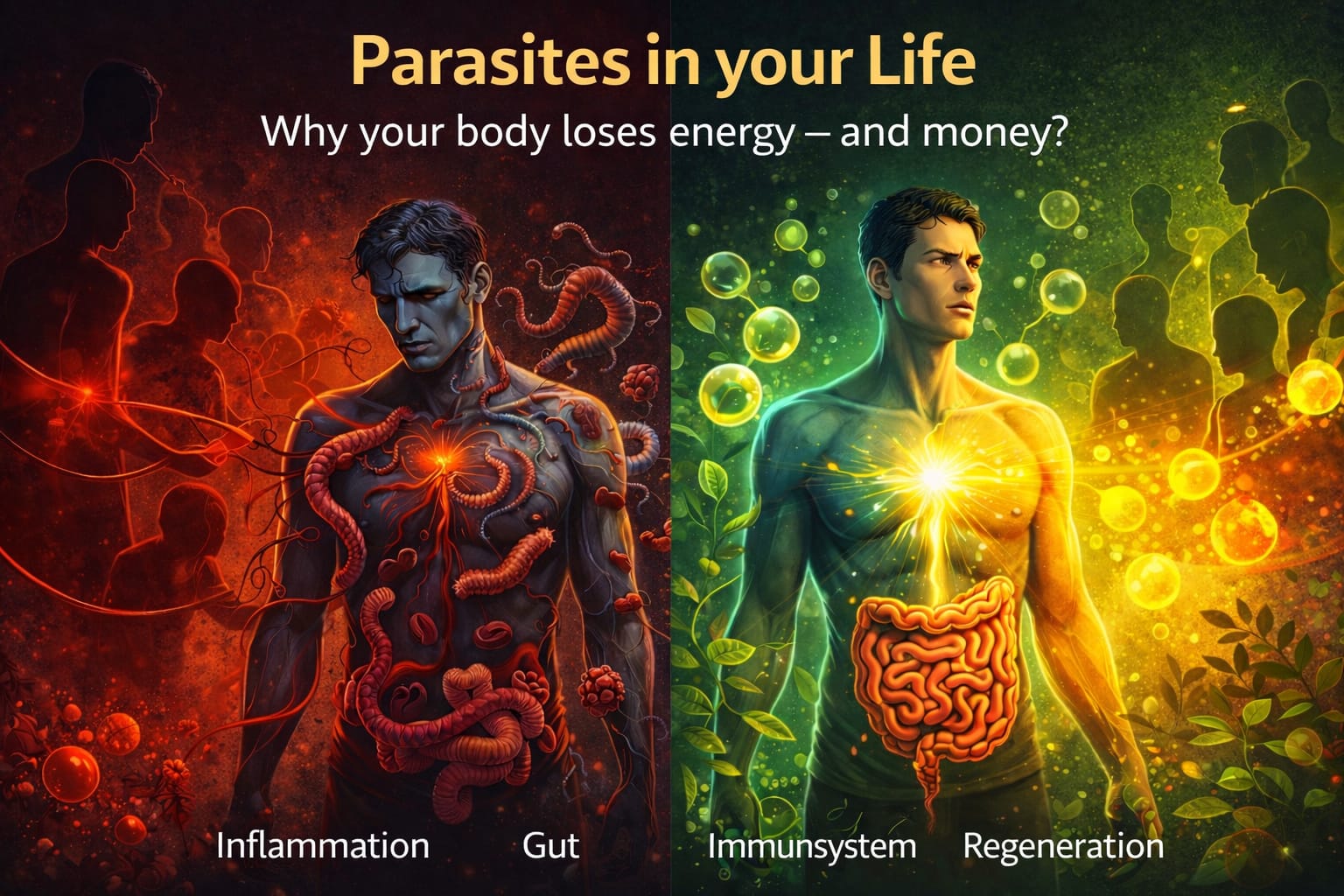
The problem arises when the body has to face an agent for a long time that is not effectively removed. One such factor can be parasites.
In many cases, they do not cause sudden illness, but function in the body for months or years, constantly affecting the immune system, gut microbiome and metabolic processes.
The result can be a situation in which the body is constantly in a state of chronic struggle – which over time leads to a decline in energy, impaired recovery and persistent low-grade inflammation.
Parasites affect the body in many ways.
Some of them live in the intestines, others may reside in the liver, bile ducts or body tissues. In each case, the body tries to respond to their presence by activating defense mechanisms.
The immune system then begins:
If such a situation lasts for a short time, the body can cope with it.
However, if it lasts for months or years, it can lead to chronic stress on the immune system.
Instead of concentrating on recovery and rebuilding, the body functions in constant mobilization mode for long periods of time.
One of the more common effects of long-term parasite presence is persistent low-grade inflammation.
It does not necessarily manifest itself as an acute infection. In many cases, it takes the form of subtle but chronic symptoms.
The most commonly observed are:
In practice, this means that the body is constantly “putting out fires” instead of returning to a natural state of balance.
Every immune response requires energy.
The body then consumes:
If such a struggle lasts for a long time, it begins to be felt in daily functioning.
Many people then describe a condition that is difficult to explain with simple exhaustion.
It appears:
The body then operates in a continuous compensation mode.
Much of the immune system is located in the gut. It is estimated that up to 70% of immune cells are associated with the gastrointestinal tract.
Parasites can affect:
If the microbiome is disrupted, it can affect not only digestion, but also the functioning of the entire immune system.
Therefore, restoring intestinal balance plays a huge role in many strategies for working with the body.
That’s why it’s becoming increasingly common to use preparations that support the microbiome and cleanse the body at the same time, instead of acting only symptomatically.
Some parasites, such as flukes, can reside in the liver or bile ducts.
The liver is one of the most important organs responsible for:
If it is stressed for a long time, the body may react:
In practice, it is very common to observe a situation in which the body struggles with symptoms for a long time, but the main cause is not identified.
Many people then try to deal only with isolated symptoms:
However, if the body is still under the influence of an aggravating factor, the effects may only be short-lived.
This can be compared to a situation in which the body extinguishes inflammation over a long period of time, instead of regaining full biological balance.
Many people use herbal supplements, but the key factor is not only the formulation itself, but also the form of administration.
In traditional supplements, some of the active ingredients:
Therefore, in recent years, increasing attention has been paid to technologies that increase the bioavailability of active substances.
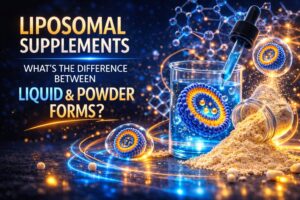
One of the solutions used in modern phytotherapy is liposomal technology.
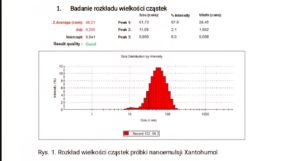
It involves encapsulating active ingredients in microscopic lipid structures called liposomes.
Liposomes are made of phospholipids – the same compounds that make up cell membranes.
This allows them to:
In the context of health, parasites are most often referred to in biological terms.
However, many people note that a similar mechanism can also occur at the psychological and social level.
This is not about literal parasites, but about situations in which a person is in an environment or relationship for a long time that:
Under such conditions, the nervous and immune systems can also remain in a state of constant mobilization.
In many cases, health improvement starts with a decision.
A person begins to notice that the previous lifestyle or environment does not support his body.
It is this moment that is the first impetus for change.
The decision may concern:
Two approaches to improving health can be seen in practice.
The first involves starting with the body – improving gut function and the microbiome.
The second begins with the mind – a conscious decision to change one’s lifestyle.
In practice, the two directions complement each other.
An organism overloaded biologically or psychologically begins to lose energy.
Over time, this can affect:
Improving the functioning of the body, therefore, often leads not only to better health, but also to a better quality of life.
It is not always easy to immediately recognize the cause of health problems. However, there are some signals that may indicate that the body is in a state of overload.
A constant feeling of fatigue that does not go away even after rest.
Flatulence, irregular bowel movement, feeling of heaviness after meals.
Memory and attention problems.
Weakened immunity and greater susceptibility to disease.
The feeling that the body never returns to full balance.
More and more people are beginning to look at health not only in terms of responding to problems, but also as a long-term investment in themselves and their life energy.
An organism that functions in biological balance has a much greater ability to regenerate, adapt and cope with daily challenges.
Therefore, in practice, many people opt for an approach that combines:
In this context, the following are also playing an increasingly important role modern forms of plant supplements, which, thanks to their increased bioavailability, can be used more efficiently by the body.
For many, such a step becomes the beginning of a broader change – improved well-being, more energy and a more health-conscious approach.
In the article How to find out if you have parasites we also describe methods that can help you recognize the first signs of body overload.
Parasites can affect the body in more complex ways than is often assumed.
Their presence can lead to:
That’s why more and more attention is being paid to approaches that simultaneously support the body’s cleansing and regeneration.
In this context, both properly selected plant raw materials and technologies that increase the bioavailability of active substances – such as liposomal systems – are important.
In practice, many people start with the first step – supporting the body’s natural cleansing with highly bioavailable plant preparations.
An example of such a solution is the set Liposomal Detox 2×30ml – currently available at a promotional price
If you’re interested in the topic of parasites and their effects on the body, it’s also worth exploring other articles discussing the issue more broadly.
1️⃣ Symptoms of parasites in humans
2️⃣ How parasite infection occurs – the most common routes of infection
3️⃣ Parasites and chronic fatigue – can they cause lack of energy?
4️⃣ Parasites and intestinal problems
5️⃣ Parasites and skin problems
6️⃣ Parasites in your life
7️⃣ Human flukes – parasites of the liver and bile ducts
If this topic is important to you
Leave your email – I’ll let you know when there are new articles
and materials on the site.
No spam. Only valuable content.



We use cookies to improve your experience on our site. By using our site, you consent to cookies.
Manage your cookie preferences below:
Essential cookies enable basic functions and are necessary for the proper function of the website.
These cookies are needed for adding comments on this website.
Google Tag Manager simplifies the management of marketing tags on your website without code changes.
Statistics cookies collect information anonymously. This information helps us understand how visitors use our website.
Google Analytics is a powerful tool that tracks and analyzes website traffic for informed marketing decisions.
Service URL: policies.google.com (opens in a new window)
SourceBuster is used by WooCommerce for order attribution based on user source.